
Manganese demand landscape 2025
- Manganese is primarily used as a precursor for ferroalloys in steelmaking accounting for close to 90% market share
- Steel continues to and is expected to dominate as the primary demand segment for the manganese industry
- However, demand for battery-grade manganese is on the rise, driven by the expanding EV and ESS markets, and is forecasted to see significant growth over the next decade.
Emerging Technologies Focus on Enhancing Lithium-ion Batteries
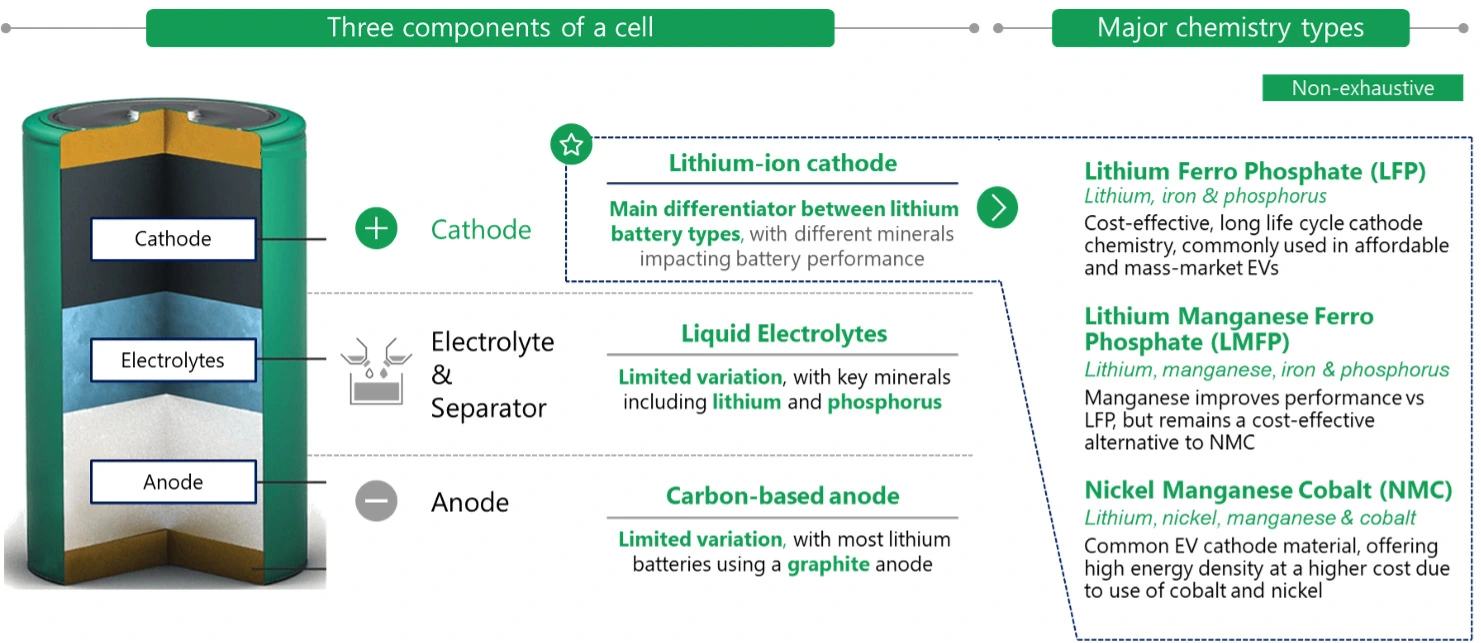
HPMSM and HPMO are used in battery cathode materials
HPMSM
Refined battery-grade manganese salt (~32% Manganese) produced via hydrometallurgical processing – a low-carbon, energy-efficient alternative to electrolytic routes
Used in lithium-ion battery cathode materials such as Nickel-Manganese-Cobalt (NMC) and Lithium-Manganese-Nickel-Oxide (LMFP), to improve energy density and reduce reliance on cobalt and nickel
HPMO
High-purity oxide produced through controlled oxidation of manganese feedstock, with high resistance and high density, HPMO acts as catalyst for reactions
Applied in next-generation battery chemistries (LMFP/LMNO), specialty ceramics, and sustainable HPMSM production pathways
HPEMM
High-purity metallic manganese (approx 99.7% Manganese) produced by electrolytic deposition, characterized by excellent conductivity and consistency
Used as feedstock for HPMSM manufacturing and directly in cathode active material production for high-performance lithium-ion batteries
Increased usage of manganese in Li-ion batteries is being explored to reduce overall battery cost and improve performance
OEMs are moving to higher manganese content batteries
2022

- Mass production of LMFP began in 2022
- Tesla validated use in 2024

2023

Gotion announced its LMFP L600 cell which boasts a range of up to 1,000km

2023

BYD launched second generation LMFP in August 2024

April 2025

Ford announced it’s delivering a game-changing LMR cell with integration into its vehicle lineup before 2030

May 2025

Plan to deploy LMR cells by 2028

2025
And many other OEM groups are working on higher manganese content cells
Geographic Market Share across the Battery-Grade Mn Value Chain
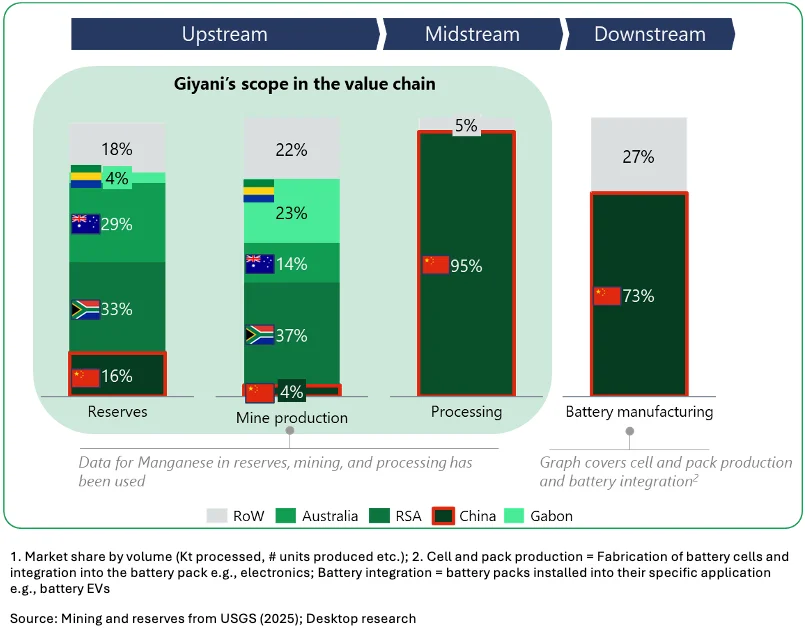
- South Africa, Gabon, and Australia lead in manganese mining (~74%), but midstream and downstream activities remain heavily China-dependent
- China’s 95%+ control of midstream processing creates supply chain vulnerability, creating opportunity for Western-aligned producers
- Giyani is leading the shift to capture market share from China, via a de-risked, low-carbon, process that is deployable worldwide
Global Battery-Grade Manganese Market Expected to Enter a Supply Deficit by 2029
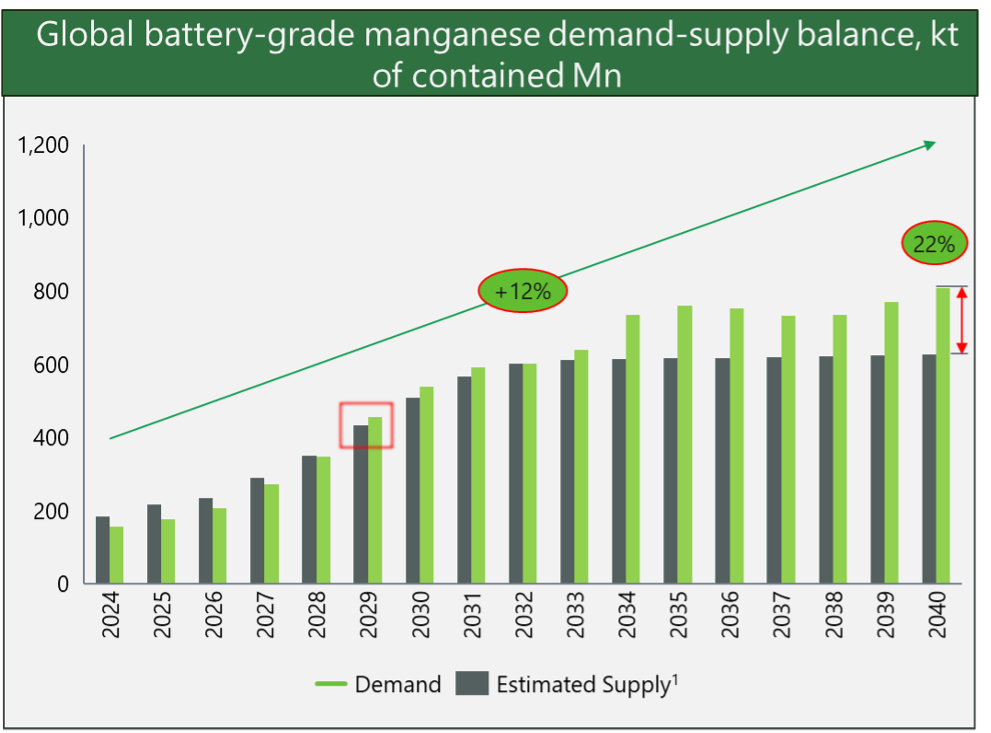
- Even with China, market expected to enter a supply deficit from 2029 onwards, driven by strong demand growth at +12% p.a. to 2040
- Accelerating EV and stationary battery adoption fuels global demand growth and powers the energy transition
- Manganese-rich battery chemistries are gaining traction as substitution for nickel and cobalt, driving efficiency gains and cost savings
- Although supply grows to ~2x in the 2020s as projects come online, a plateau is expected in the 2030s intensifying the deficit
The Supply Deficit is exacerbated in the West
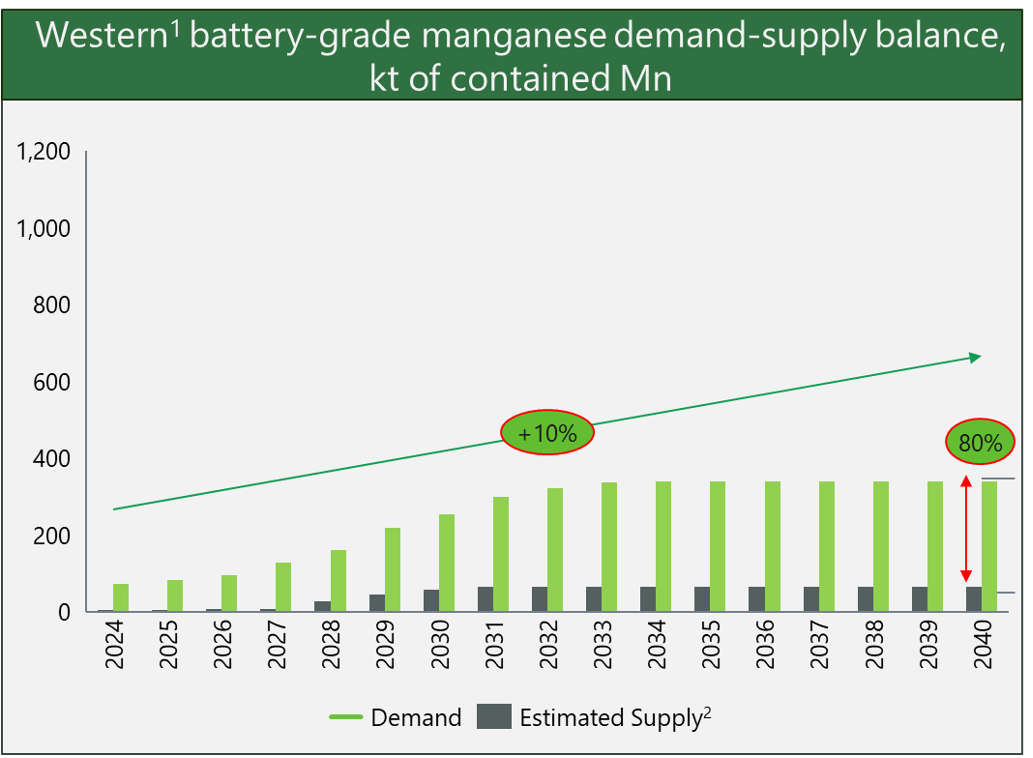
- Increasing supply deficit expected in the West as demand outpaces supply through to 2040
- 10% p.a. growth in demand from 2024 to 2040 in North America and the EU to ~350kt driven by increased localization of battery value chains
- Increased localization largely driven by need to de-risk supply chains and meet government regulation e.g., CRMA3 and IRA4
- Supply grows from <10kt to just under 70kt as new projects enter, however, growth remains limited
- Higher cost structures compared to China limit localisation potential upstream
Price premiums continue for Western Manganese supply
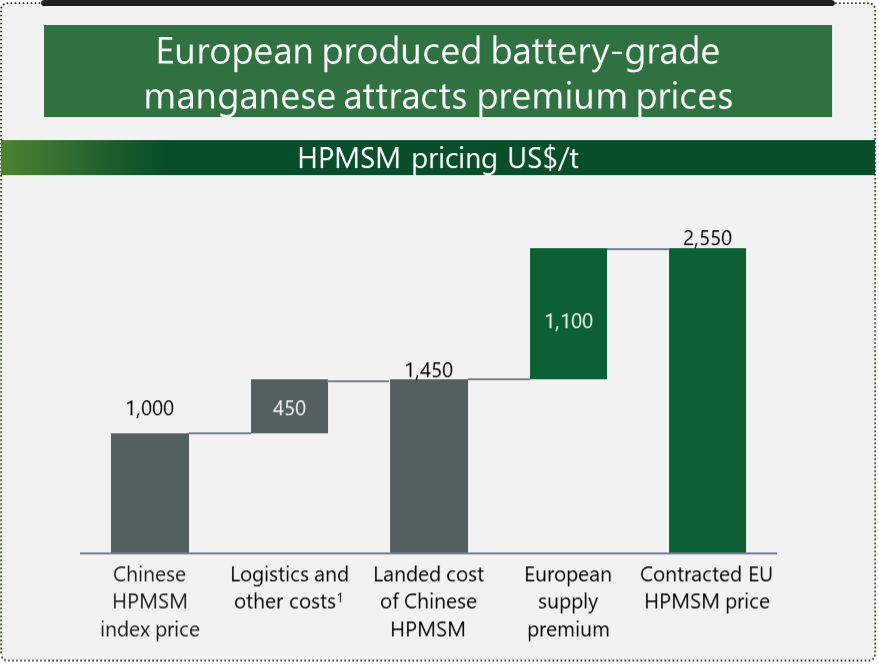
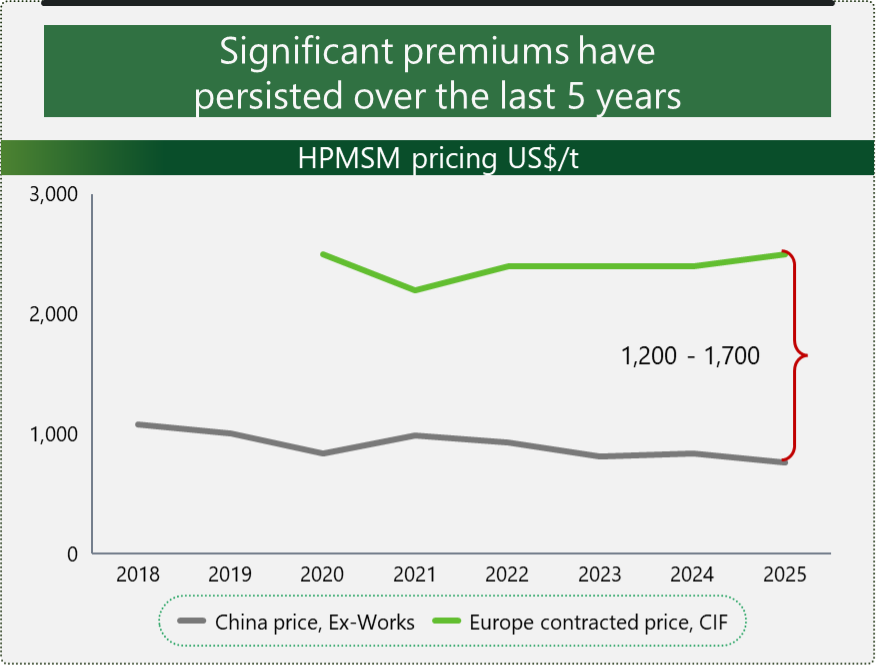
- Chinese indices and Western prices divergent, with negotiated/ contracted prices of EU HPMSM attracting US$1,000/t+ premiums
- Supply deficit in the West, low cost of Mn compared to Nickel and Cobalt, ESG credentials seen as the major drivers for the premium
- Divergent prices have been observed for the last 5 years as long-term offtake contracts are typically signed in the battery-grade market
- Premium currently observed for <5% of market supply - securing early approval and offtake will be a key margin driver in the market
- Divergent prices have been observed for the last 5 years as long-term offtake contracts are typically signed in the battery-grade market
- Premium currently observed for <5% of market supply - securing early approval and offtake will be a key margin driver in the market